Land Is Life. So, How Do We Protect It?
Tereza Bizkova reports on the impact of land stewardship on regeneration and speaks with project founders about web3's role.
By Tereza Bizkova | February 23rd, 2026
You may remember a post that went viral a few years ago, showing a reforestation “miracle” in Brazil. It was shared by photographer Sebastião Salgado, documenting land his family owned in the Minas Gerais region.
Salgado returned to the property in the 1990s after coming back from Rwanda, emotionally depleted by his work documenting the genocide. He said the land was “as sick as he was,” with only about 0.5% of it covered in trees. Decades of cattle farming stripped the soil, dried out water sources, and cleared most of the native vegetation. But instead of selling the property, they decided to restore it. Over the next two decades, they planted more than two million native trees and, as the forest grew back, water returned, and wildlife followed.
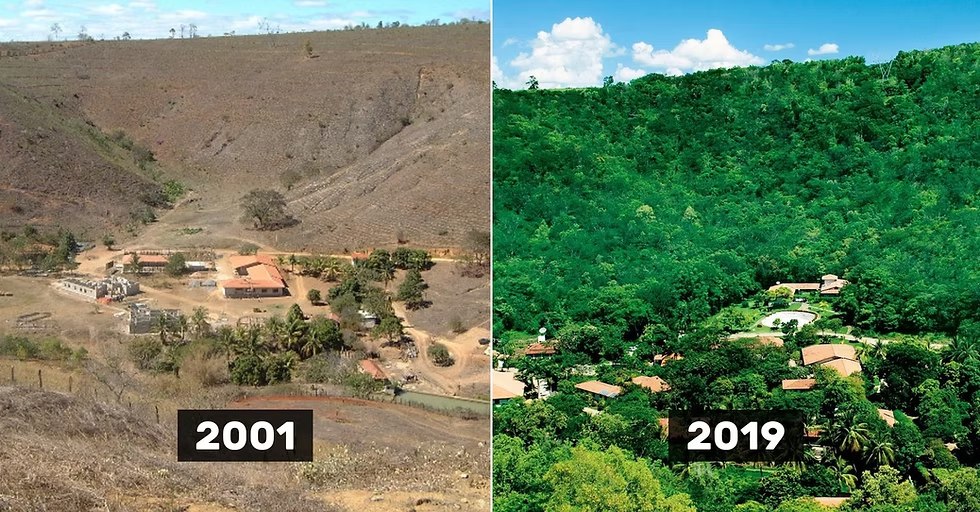
Courtesy of Instituto Terra
It’s hard not to be struck by this transformation, but even harder not to ask: If depleted land can recover this fully with time and care, why isn’t it happening everywhere?
There are more than enough reasons for it to be. Already today, human activity has altered roughly 70% of our planet’s ice-free surface, with up to 40% now classified as degraded. This shows up through eroding soils, reduced water availability, biodiversity loss, and even ecosystems that no longer buffer communities from heat, floods, or droughts. Simply put, land sits upstream of many crises we still tend to treat as separate problems.
Acting on land also offers one of the clearest payoffs available. As Ibrahim Thiaw, head of the UN Convention to Combat Desertification, notes, land restoration is “the cheapest solution to climate change and biodiversity loss.” Because land systems are deeply interconnected, the gains are not only ecological but also economic and social. Global assessments suggest that restoring degraded land at scale could generate trillions of dollars in ecosystem services, from food production and clean water to flood protection, while supporting jobs and livelihoods, at a cost far lower than many other climate responses.
The capacity for recovery exists, the need is clear, and the benefits are well understood. But how land is held, governed, and cared for is equally important. What systems actually enable and scale land regeneration, and how might web3 tools support them?
Land as a living, not liquid, asset
The mechanics of land regeneration are surprisingly straightforward. Remove chronic stress (overgrazing, repeated burning, soil disturbance, and clear-cutting) and degraded land often begins recovering on its own. Some native seeds can lie dormant in depleted soil for decades and when conditions shift, they activate. Native species return, roots stabilise ground, organic matter builds—and these gains further reinforce each other.
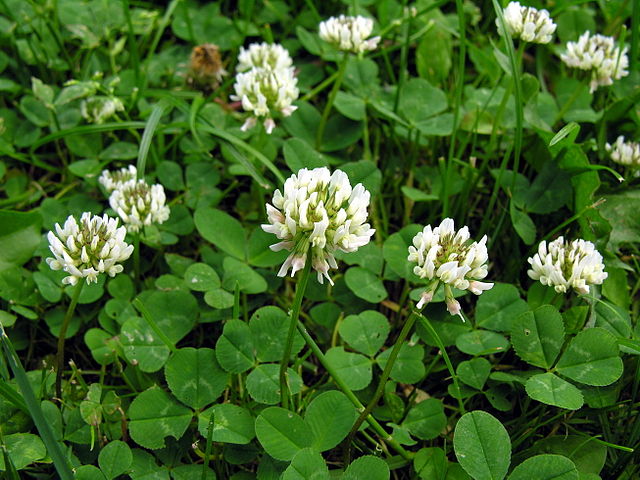
Native clover seeds (Trifolium) can remain dormant for decades. Once germinating, they fix atmospheric nitrogen and help rebuild depleted soils. Courtesy of Lifeder.
While nature does most of the work, human efforts focus on what ecosystems can’t manage alone: seeding where seed banks have been exhausted, erosion control on exposed slopes, and assisted regeneration when degradation is too severe.
But unlike nature, we don't often possess that kind of patience. Regeneration is a long-term game with no immediate payoff. Soil building is slow, forest complexity takes time, and the returns don't belong to a single owner. Cleaner water, steady climate, biodiversity—these are shared benefits spreading across communities (and generations). Our economic systems aren't built to reward that kind of sustained, collective gain.
We tend to value land for what we can take from it: timber, cattle, crops. Extract as much, and as quickly, as possible. When land is valued for what it can sustain over time, the hierarchy shifts. We remove ourselves as the masters, the "owners", and put the land above us. We become the caretakers, the "stewards."
Stewardship is surrendering to the land, tending to it on its terms, not ours. Diogo Jorge, working with AgroforestDAO, sees this constantly.
Usually, reforestation means taking a degraded area and planting many tree saplings. Maybe people will get back there after a few months to cut the grass, but usually there is no stewardship of the area, no short-term crops to be harvested, no pruning of carbon feeding the soil, no food production, and no cultural legacy.
Good intentions fade. Economic pressures return. Without sustained care, the cycle repeats.
When stewardship truly takes root, the difference is huge. Indigenous communities have been protecting their forests for generations; research across the tropics finds Indigenous territories have deforestation rates 17-26% lower than unprotected areas. They notice illegal logging immediately, adapt practices to seasons and soil, and respond to what the land needs because they've learned what it's like to live with the outcomes.
This kind of stewardship can be engineered at larger scales, too. By 1987, logging and cattle ranching in Costa Rica had stripped the country down to roughly 25% forest cover. In response to collapsing biodiversity, the government banned unpermitted forest clearing in 1996 and launched a Payments for Environmental Services program a year later. Landowners would get about $64 per hectare annually to maintain or replant forest, funded by a fossil fuel tax. "The pocket," one official noted, "is the quickest way to get to the heart."
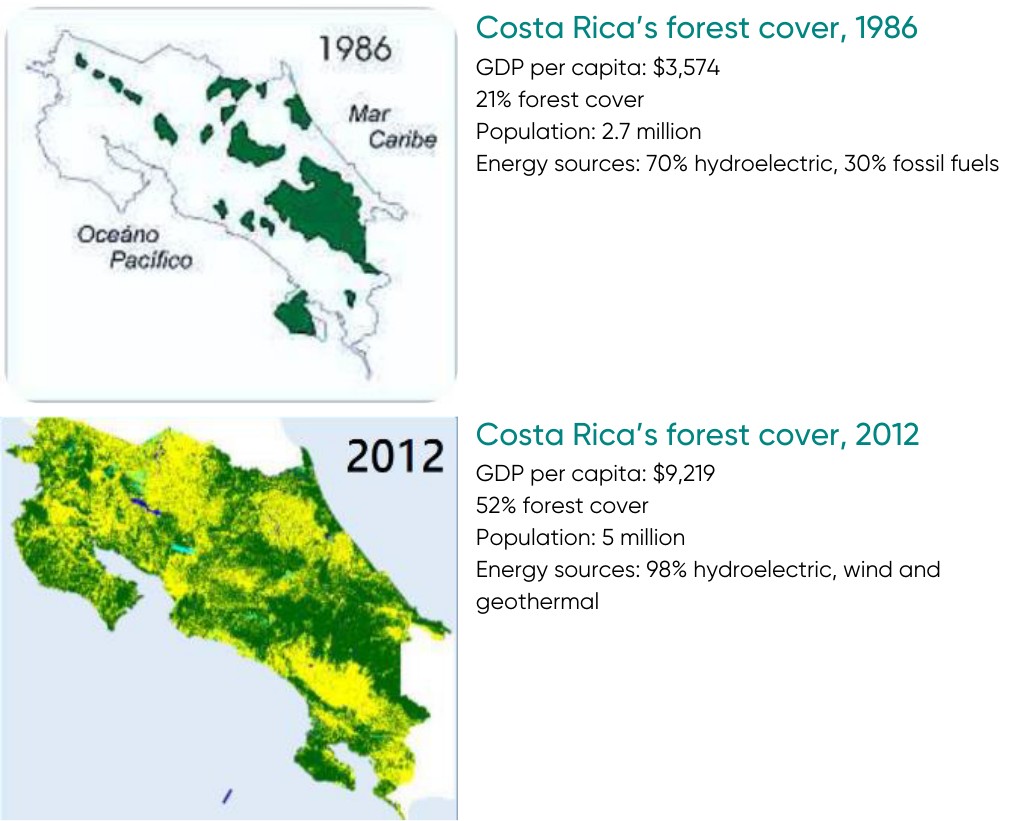
Reforestation didn't prevent Costa Rica’s economic growth—both flourished together. Courtesy of Sustainable Agriculture Network.
Thousands of farmers abandoned cattle for trees. Forest cover climbed back. More than a million hectares protected—a fifth of the nation's territory. Today those forests are alive with sloths, toucans, and strawberry poison-dart frogs. Costa Rica managed to halt and reverse deforestation by making stewardship the rational economic choice.
The tragedy of the commoners
Say there's a rancher in Colombia's páramos who pulls cattle off degraded slopes to let native vegetation return. The páramo's sponge-like soil begins to recover, water supply to the towns below steadies, and carbon gets stored. But the rancher just lost their livelihood. The benefits they're "producing" don't show up on anyone's balance sheet, least of all theirs. Economists call this the externality problem: those who invest in land health create value they can rarely capture.
Even in the rare cases the value is recognised (like through carbon credits, watershed payments, or conservation grants), the money still doesn't show up. Most agricultural and commercial lending operates on 3- to 7-year cycles; land restoration operates on 20- to 50-year horizons. Even landholders who want to regenerate often can't access financing structured for what the land actually needs.
Then there's land fragmentation. A watershed spans dozens of parcels under different owners with different pressures, but there's rarely infrastructure to coordinate across them. Bioregional networks—organising at the scale of watersheds or ecosystems—that could pool resources and coordinate care barely exist. The unit of regeneration is the landscape, but the unit of ownership is the parcel.
And in many parts of the world, even that unit is contested: millions of smallholders and Indigenous communities who already steward land don't hold formal legal title to it, which locks them out of financing, carbon credit programs, and any long-term restoration investment.
Antonio Paglino, working on RiFai Sicilia, sees these problems stacking up.
Currently, there are no effective ways to funnel financing and investments into a network and portfolio of projects. The biggest opportunity right now is bootstrapping bioregional networks with the liquidity needed to acquire land and tools and pay back investors with yield from regenerative production.
AgroforestDAO's Diogo sees the problem as more than structural.
There is a dominance of a modern vision of agriculture, where the value lies in the sales of commodities, usually short-term crops. We need to innovate creating ways to bring back community agriculture with a 21st century approach that values cultural and intellectual capital, capacity building, mutual support, natural rhythms, biodiversity.
The tragedy of the commons, as Garrett Hardin framed it, was that shared resources get destroyed because individuals act in self-interest. But the deeper tragedy is the inverse: the people who would steward the land—who already know how, who are already doing it at small scales—can't, because the financing, coordination, and incentives weren't built for that kind of care.
The infrastructure for extraction is everywhere: commodity markets, industrial supply chains, land speculation. The infrastructure for stewardship barely exists. Can web3 help build it?
Coordination, not revolution
GainForest is a nonprofit that develops conservation technology alongside Indigenous and local communities. In the Brazilian Amazon, that looks like drones over forests managed for generations, environmental DNA collected from backpack-sized mobile labs, and species logged through apps that work offline. AI and blockchain handle verification and record-keeping, but data sovereignty stays with the communities.
What gets built on that data depends on what each community needs. One riverine settlement on the Rio Negro trained an AI model on drone footage to identify ripe nut trees, shortening their harvest from over a week to a few days. Another community, the Inhaã-bé near Manaus, spotted a drought three weeks before media reported it and started stockpiling supplies while neighboring villages went unprepared.
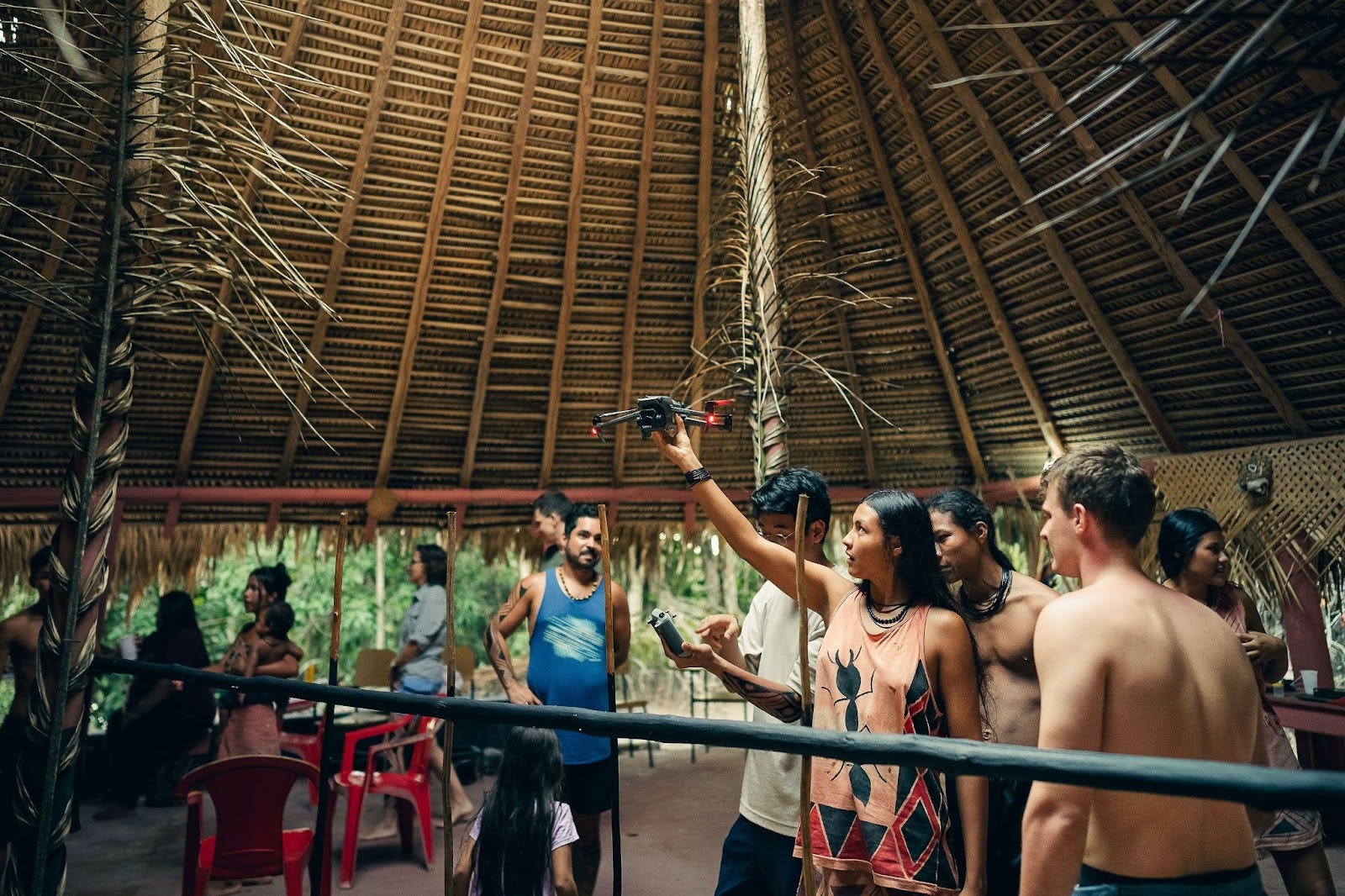
GainForest team working side by side with the Aldeia Inhaâ-bé community. Courtesy of GainForest.
But it’s the very same data that helps these communities manage their land that can also bring in the funding to keep doing it.
GainForest packages verified conservation outcomes into what they call “ecocerts”, impact certificates that go beyond carbon: biodiversity monitoring, habitat restoration, reforestation progress. Funders purchase them directly, and the money flows back to the communities that produced the work.
In 2024, that added up to $32,000 distributed across 28 communities around the globe. People paid to observe and document ecosystems they already live in. None of this replaces existing mechanisms: payments for ecosystem services, community forestry, bioregional coordination. But it can supply plumbing those systems are missing.
A simple blockchain smart contract can be a powerful tool. Set it to release funds when canopy cover hits a threshold, and it just waits. Five years, or fifteen. There's no need to renew a budget or call a board vote. Code is patient in ways that capital usually isn't, and land regeneration, more than almost anything, needs patient money.
And there’s more: Onchain treasuries let networks pool resources across borders without having to form legal entities in every country. Stewardship records on tamper-proof ledgers could give communities without formal title something they've never had: a legible history of care that lenders and funders can read.
On the funder side, outcomes are verifiable; on the steward side, the money is committed, the rules are transparent, and the labour is on record. Trust, for once, runs both ways.
GainForest isn't alone in bringing web3 tools to land regeneration. Silvi Protocol, Regen Network, AgroforestDAO, Open Forest Protocol, RiFai Sicilia, and others are each working on different pieces, from reforestation funding to carbon credit verification to harvest-share NFTs. The space is young and scattered, but something is starting to take root.
We pin satellite raster data directly into IPFS as well. See below aboveground biomass accumulation and trends... pic.twitter.com/hk2l59xVSf
— Silvi🤳🌳 (@SilviProtocol) October 13, 2025
Silvi tracks restoration through geodata, imagery, and cryptographic records. Courtesy of Silvi Protocol.
Djimo Serodio, who founded Silvi, is careful not to overstate any of it.
It's too early to derive confidence in meaningfulness.
Regeneration predates web3 by millennia, and the real dynamics, he stresses, are economics and game theory.
I think web3 has both technically and philosophically played an important role in at least pointing society in a better direction while building an alternative foundation from which regenerative values can be realised.
But meaningful impact at scale? Still to be proven.
Tokenising carbon or land can move capital. But without governance enforcing care on the ground, it’s just speculation in a green wrapper. What does a token pegged to a hectare of forest mean if no one is managing fire risk or reading what the land needs across decades?
Blockchain doesn't plant trees. Smart contracts don't build soil. And the people doing this work on the ground are rarely the ones with crypto wallets. Some projects, GainForest included, design around this with shared accounts and local field officers. Others don't, and end up adding dependencies instead of capacity.
Regeneration is not anti-technology. It's anti-disconnection. Technology that tightens the loop between land, the people caring for it, and the capital supporting that care is worth building. Technology that loosens it usually isn't. Protecting land, in the end, means choosing to stay connected to it—economically, politically, physically. The tools are just how we make that choice easier to make.
The choice really is the important part. Salgado owned his land in Minas Gerais for decades before he decided to restore it. Ownership wasn't the barrier or the solution—it was having the resources and freedom to make a choice most landholders can't afford. We need to build systems that make it not only possible, but also rewarding, for everyone. Whether through policy, local stewardship, new funding models, or tools like web3, the real work is aligning incentives with the patience ecosystems require, and staying with that commitment long enough for it to make a difference.
This article represents the opinion of the author(s) and does not necessarily reflect the editorial stance of CARBON Copy.